- NEW: D.C. hospital admits patient with symptoms 'that could be associated with Ebola'
- Three sheriff's deputies who helped deliver quarantine order are placed on leave
- Thomas Eric Duncan is the first person diagnosed with Ebola on American soil
- Sanitation company says it was turned away from apartment where four family members are quarantined
(CNN) -- Howard University Hospital in Washington has admitted a patient with symptoms "that could be associated with Ebola," hospital spokeswoman Kerry-Ann Hamilton said Friday. The patient, who was not named, recently traveled to Nigeria and presented with the symptoms upon his or her return, she said. The patient is in stable condition.
"In an abundance of caution, we have activated the appropriate infection control protocols, including isolating the patient," Hamilton said. "Our medical team continues to evaluate and monitor progress in close collaboration with the CDC and the Department of Health."
The news comes four days after the first Ebola patient to be diagnosed in the United States was put in isolation at a hospital in Texas.
Thomas Eric Duncan was hospitalized days after his arrival from Liberia. The deadly virus has killed more than 3,300 people in Guinea, Liberia and Sierra Leone.
Duncan landed in Dallas on September 20 and started feeling sick several days later. He went to Texas Health Presbyterian Hospital on September 26 with a fever and abdominal pain, hospital officials say. He was sent home with antibiotics but returned in an ambulance two days later, when he was admitted and placed in isolation.
 Ebola victim's half-brother speaks
  Ebola patient in U.S. in stable condition
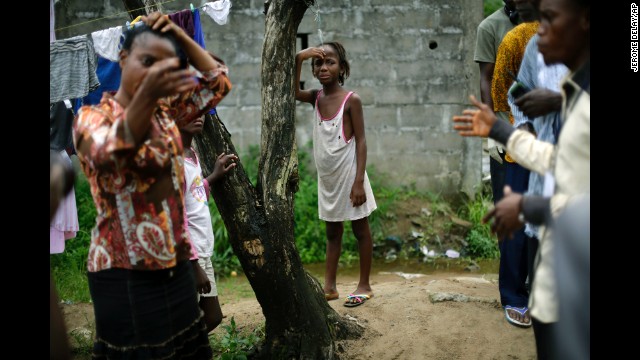 A girl cries as community activists approach her outside her Monrovia, Liberia, home on Thursday, October 2, a day after her mother was taken to an Ebola ward. Health officials say the Ebola outbreak in West Africa is the deadliest ever. More than 3,000 people have died, according to the World Health Organization.
 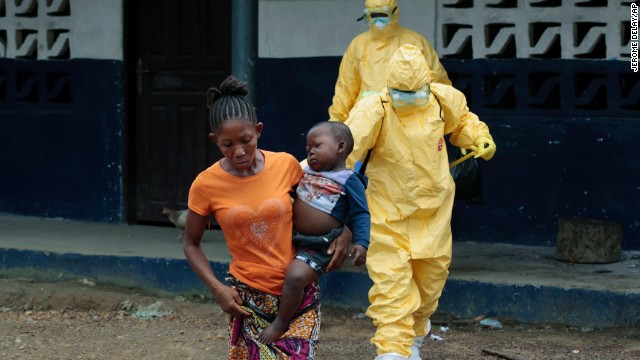 Marie Nyan, whose mother died of Ebola, carries her 2-year-old son, Nathaniel Edward, to an ambulance in the Liberian village of Freeman Reserve on Tuesday, September 30.
 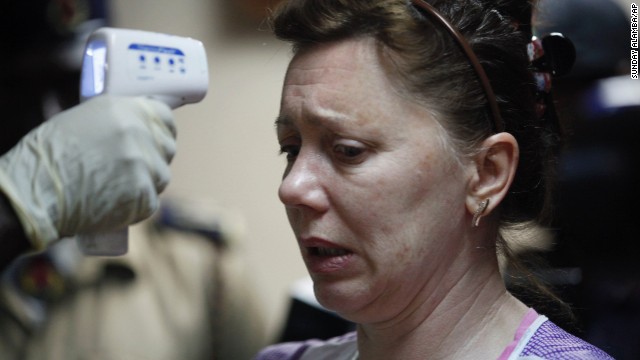 A health official uses a thermometer Monday, September 29, to screen a Ukrainian crew member on the deck of a cargo ship at the Apapa port in Lagos, Nigeria.
  Children pray during Sunday service at the Bridgeway Baptist Church in Monrovia, Liberia, on Sunday, September 28.
  Residents of the St. Paul Bridge neighborhood in Monrovia take a man suspected of having Ebola to a clinic on September 28.
  Workers move a building into place as part of a new Ebola treatment center in Monrovia on September 28.
 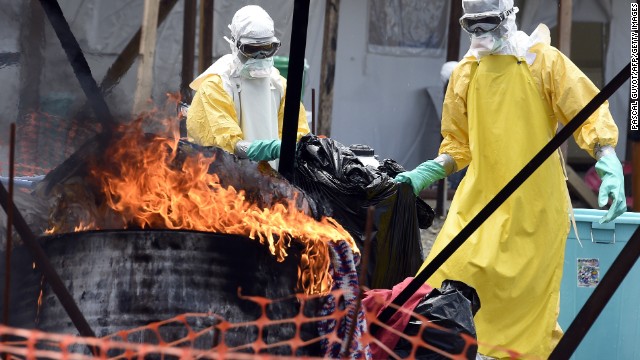 Medical staff members at the Doctors Without Borders facility in Monrovia burn clothes belonging to Ebola patients on Saturday, September 27.
  A police officer patrols a road in Monrovia on September 27 after a body was found in the center of the city.
  Tents are set up as health control centers at an air base near the Senegalese capital of Dakar on September 27. After closing its borders on August 21, Senegal opened an air corridor to allow humanitarian aid to be delivered to the three areas most affected by the Ebola virus.
 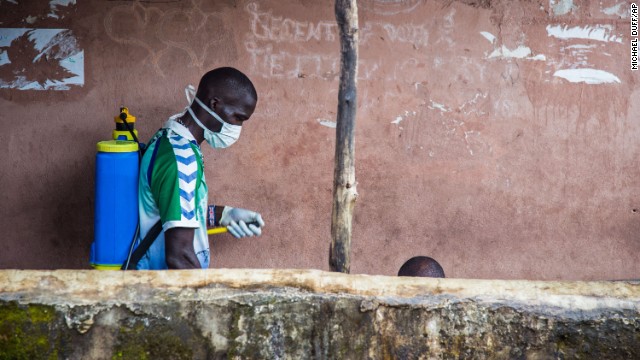 A health worker in Freetown, Sierra Leone, sprays disinfectant around the area where a man sits before loading him into an ambulance on Wednesday, September 24.
 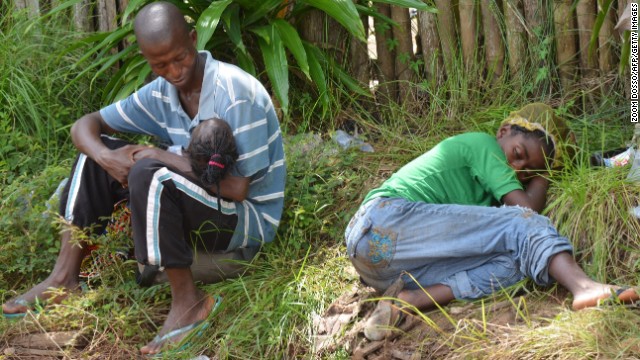 People wait outside a new Ebola treatment center in Monrovia on Tuesday, September 23.
  Health workers in protective suits work outside an Ebola treatment center in Monrovia on September 23.
 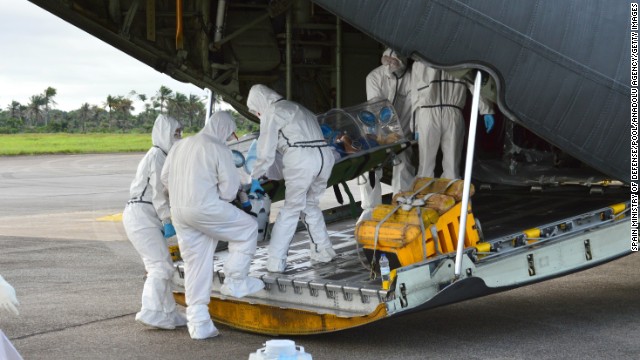 Medics load an Ebola patient onto a plane at Sierra Leone's Freetown-Lungi International Airport on Monday, September 22.
 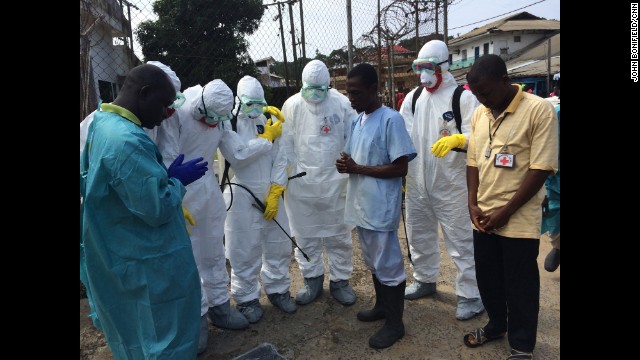 A team that handles the management of dead bodies prays with Saymon Kamara, far right, on September 22 in Monrovia. Kamara's mother died from complications of high blood pressure.
  A few people are seen in Freetown during a three-day nationwide lockdown on Sunday, September 21. In an attempt to curb the spread of the Ebola virus, people in Sierra Leone were told to stay in their homes.
 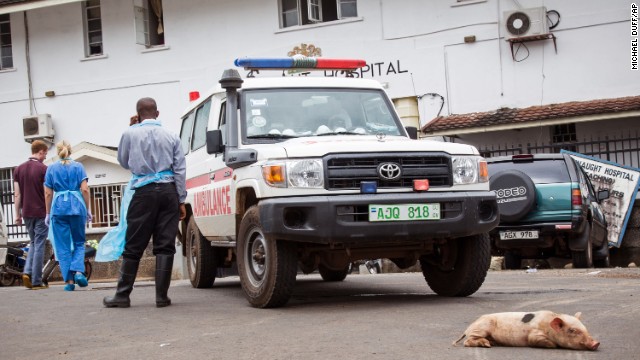 A baby pig sleeps in front of an ambulance at the Connaught Hospital in Freetown on September 21.
  Supplies wait to be loaded onto an aircraft at New York's John F. Kennedy International Airport on Saturday, September 20. It was the largest single shipment of aid to the Ebola zone to date, and it was coordinated by the Clinton Global Initiative and other U.S. aid organizations.
  A volunteer health worker in Freetown talks with residents on how to prevent Ebola infection and identify symptoms of the virus on September 20. Bars of soap were also distributed.
 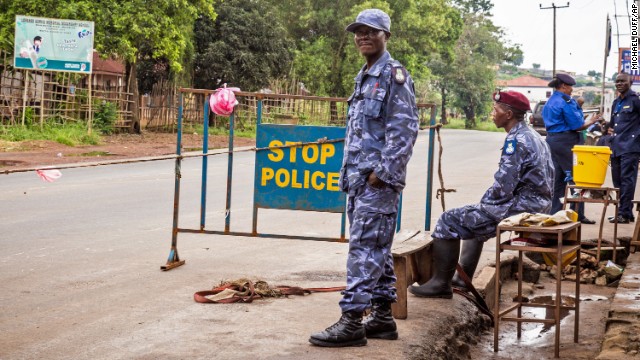 Police in Freetown guard a roadblock Friday, September 19, as the country began enforcing its three-day nationwide lockdown.
 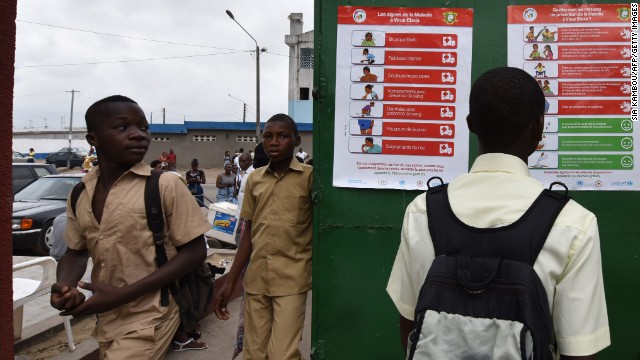 A student of the Sainte Therese school in Abidjan, Ivory Coast, looks at placards Monday, September 15, that were put up to raise awareness about the symptoms of the Ebola virus.
  Members of a volunteer medical team wear protective gear before the burying of an Ebola victim Saturday, September 13, in Conakry, Guinea.
 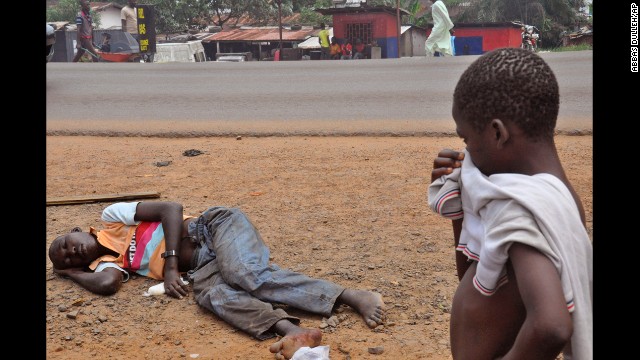 A child stops on a Monrovia street Friday, September 12, to look at a man who is suspected of suffering from Ebola.
 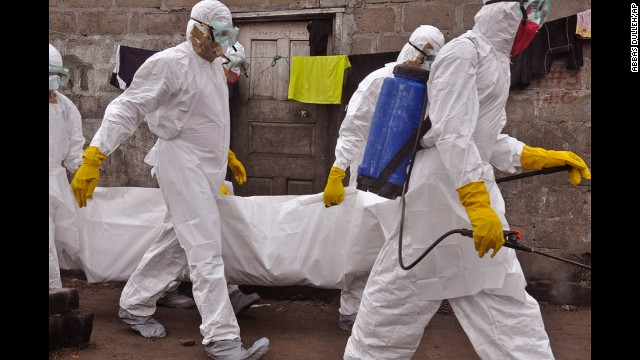 Health workers on Wednesday, September 10, carry the body of a woman who they suspect died from the Ebola virus in Monrovia.
 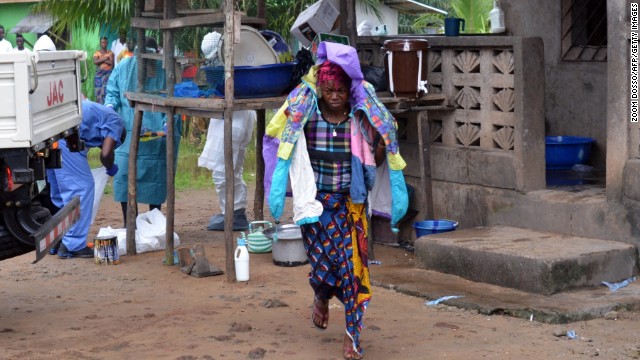 A woman in Monrovia carries the belongings of her husband, who died after he was infected by the Ebola virus.
  Five ambulances that were donated by the United States to help combat the Ebola virus are lined up in Freetown on September 10 following a ceremony that was attended by Sierra Leone President Ernest Bai Koroma.
 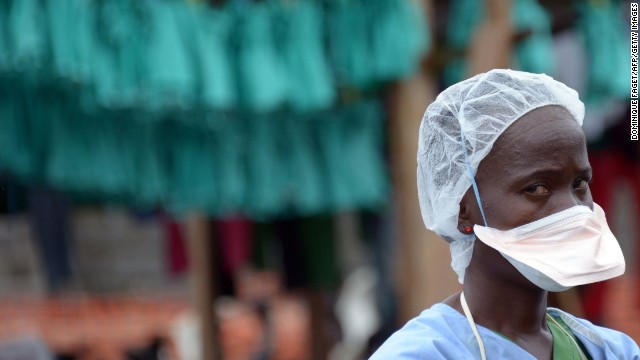 A health worker wears protective gear Sunday, September 7, at ELWA Hospital in Monrovia.
 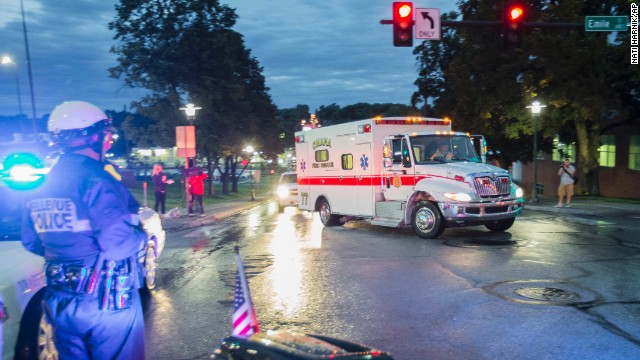 An ambulance transporting Dr. Rick Sacra, an American missionary who was infected with Ebola in Liberia, arrives at the Nebraska Medical Center in Omaha, Nebraska, on Friday, September 5. Sacra was being treated in the hospital's special isolation unit.
  Medical workers from the Liberian Red Cross carry the body of an Ebola victim Thursday, September 4, in Banjol, Liberia.
  Health workers in Monrovia place a corpse into a body bag on September 4.
  A rally against the Ebola virus is held in Abidjan on September 4.
  After an Ebola case was confirmed in Senegal, people load cars with household items as they prepare to cross into Guinea from the border town of Diaobe, Senegal, on Wednesday, September 3.
  Crowds cheer and celebrate in the streets Saturday, August 30, after Liberian authorities reopened the West Point slum in Monrovia. The military had been enforcing a quarantine on West Point, fearing a spread of the Ebola virus.
 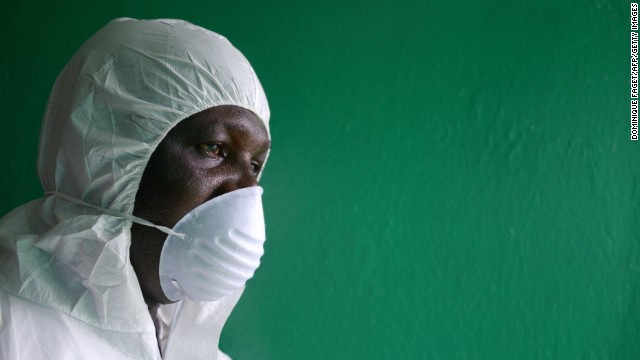 A health worker wearing a protective suit conducts an Ebola prevention drill at the port in Monrovia on Friday, August 29.
  Senegalese Health Minister Awa Marie Coll-Seck gives a news conference August 29 to confirm the first case of Ebola in Senegal. She announced that a young Guinean had tested positive for the deadly virus.
  Volunteers working with the bodies of Ebola victims in Kenema, Sierra Leone, sterilize their uniforms on Sunday, August 24.
  A Liberian health worker checks people for symptoms of Ebola at a checkpoint near the international airport in Dolo Town, Liberia, on August 24.
  A guard stands at a checkpoint Saturday, August 23, between the quarantined cities of Kenema and Kailahun in Sierra Leone.
  A burial team from the Liberian Ministry of Health unloads bodies of Ebola victims onto a funeral pyre at a crematorium in Marshall, Liberia, on Friday, August 22.
  A humanitarian group worker, right, throws water in a small bag to West Point residents behind the fence of a holding area on August 22. Residents of the quarantined Monrovia slum were waiting for a second consignment of food from the Liberian government.
  Dr. Kent Brantly leaves Emory University Hospital on Thursday, August 21, after being declared no longer infectious from the Ebola virus. Brantly was one of two American missionaries brought to Emory for treatment of the deadly virus.
  Brantly, right, hugs a member of the Emory University Hospital staff after being released from treatment in Atlanta.
  Family members of West Point district commissioner Miata Flowers flee the slum in Monrovia while being escorted by the Ebola Task Force on Wednesday, August 20.
  An Ebola Task Force soldier beats a local resident while enforcing a quarantine on the West Point slum on August 20.
  Local residents gather around a very sick Saah Exco, 10, in a back alley of the West Point slum on Tuesday, August 19. The boy was one of the patients that was pulled out of a holding center for suspected Ebola patients after the facility was overrun and closed by a mob on August 16. A local clinic then refused to treat Saah, according to residents, because of the danger of infection. Although he was never tested for Ebola, Saah's mother and brother died in the holding center.
  A burial team wearing protective clothing retrieves the body of a 60-year-old Ebola victim from his home near Monrovia on Sunday, August 17.
  lija Siafa, 6, stands in the rain with his 10-year-old sister, Josephine, while waiting outside Doctors Without Borders' Ebola treatment center in Monrovia on August 17. The newly built facility will initially have 120 beds, making it the largest-ever facility for Ebola treatment and isolation.
  Brett Adamson, a staff member from Doctors Without Borders, hands out water to sick Liberians hoping to enter the new Ebola treatment center on August 17.
  Workers prepare the new Ebola treatment center on August 17.
  A body, reportedly a victim of Ebola, lies on a street corner in Monrovia on Saturday, August 16.
  Liberian police depart after firing shots in the air while trying to protect an Ebola burial team in the West Point slum of Monrovia on August 16. A crowd of several hundred local residents reportedly drove away the burial team and their police escort. The mob then forced open an Ebola isolation ward and took patients out, saying the Ebola epidemic is a hoax.
  A crowd enters the grounds of an Ebola isolation center in the West Point slum on August 16. The mob was reportedly shouting, "No Ebola in West Point."
  A health worker disinfects a corpse after a man died in a classroom being used as an Ebola isolation ward Friday, August 15, in Monrovia.
  A boy tries to prepare his father before they are taken to an Ebola isolation ward August 15 in Monrovia.
  Kenyan health officials take passengers' temperature as they arrive at the Jomo Kenyatta International Airport on Thursday, August 14, in Nairobi, Kenya.
  A hearse carries the coffin of Spanish priest Miguel Pajares after he died at a Madrid hospital on Tuesday, August 12. Pajares, 75, contracted Ebola while he was working as a missionary in Liberia.
  A member of the Centers for Disease Control and Prevention leads a training session on Ebola infection control Monday, August 11, in Lagos.
  Health workers in Kenema screen people for the Ebola virus on Saturday, August 9, before they enter the Kenema Government Hospital.
  A health worker at the Kenema Government Hospital carries equipment used to decontaminate clothing and equipment on August 9.
  Health care workers wear protective gear at the Kenema Government Hospital on August 9.
  Paramedics in protective suits move Pajares, the infected Spanish priest, at Carlos III Hospital in Madrid on Thursday, August 7. He died five days later.
  Nurses carry the body of an Ebola victim from a house outside Monrovia on Wednesday, August 6.
  A Nigerian health official wears protective gear August 6 at Murtala Muhammed International Airport in Lagos.
 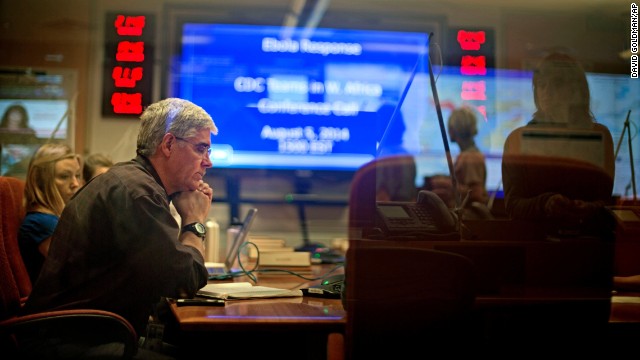 Officials with the Centers for Disease Control and Prevention in Atlanta sit in on a conference call about Ebola with CDC team members deployed in West Africa on Tuesday, August 5.
  Aid worker Nancy Writebol, wearing a protective suit, gets wheeled on a gurney into Emory University Hospital in Atlanta on August 5. A medical plane flew Writebol from Liberia to the United States after she and her colleague Dr. Kent Brantly were infected with the Ebola virus in the West African country.
  Nigerian health officials are on hand to screen passengers at Murtala Muhammed International Airport on Monday, August 4.
 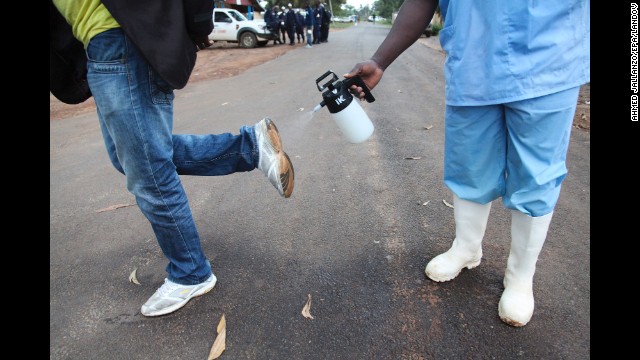 A man gets sprayed with disinfectant Sunday, August 3, in Monrovia.
  Dr. Kent Brantly, right, gets out of an ambulance after arriving at Emory University Hospital in Atlanta on Saturday, August 2. Brantly was infected with the Ebola virus in Africa, but he was brought back to the United States for further treatment.
  Nurses wearing protective clothing are sprayed with disinfectant Friday, August 1, in Monrovia after they prepared the bodies of Ebola victims for burial.
  A nurse disinfects the waiting area at the ELWA Hospital in Monrovia on Monday, July 28.
  Liberian President Ellen Johnson Sirleaf, right, walks past an Ebola awareness poster in downtown Monrovia as Liberia marked the 167th anniversary of its independence Saturday, July 26. The Liberian government dedicated the anniversary to fighting the deadly disease.
  In this photo provided by Samaritan's Purse, Dr. Kent Brantly, left, treats an Ebola patient in Monrovia. On July 26, the North Carolina-based group said Brantly tested positive for the disease. Days later, Brantly arrived in Georgia to be treated at an Atlanta hospital, becoming the first Ebola patient to knowingly be treated in the United States.
  A 10-year-old boy whose mother was killed by the Ebola virus walks with a doctor from the aid organization Samaritan's Purse after being taken out of quarantine Thursday, July 24, in Monrovia.
 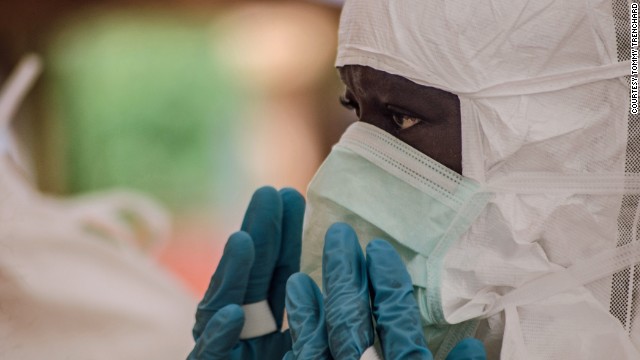 A doctor puts on protective gear at the treatment center in Kailahun on Sunday, July 20.
  Members of Doctors Without Borders adjust tents in the isolation area in Kailahun on July 20.
 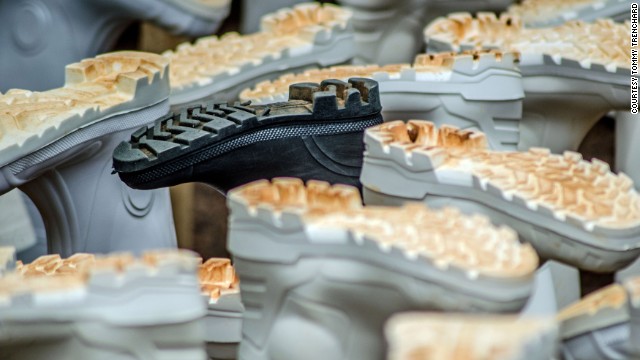 Boots dry in the Ebola treatment center in Kailahun on July 20.
  Red Cross volunteers prepare to enter a house where an Ebola victim died in Pendembu, Sierra Leone, on Friday, July 18.
  Dr. Jose Rovira of the World Health Organization takes a swab from a suspected Ebola victim in Pendembu on July 18.
  Red Cross volunteers disinfect each other with chlorine after removing the body of an Ebola victim from a house in Pendembu on July 18.
  A dressing assistant prepares a Doctors Without Borders member before entering an isolation ward Thursday, July 17, in Kailahun.
  A doctor works in the field laboratory at the Ebola treatment center in Kailahun on July 17.
  Doctors Without Borders staff prepare to enter the isolation ward at an Ebola treatment center in Kailahun on July 17.
  A health worker with disinfectant spray walks down a street outside the government hospital in Kenema on Thursday, July 10.
  Dr. Mohamed Vandi of the Kenema Government Hospital trains community volunteers who will aim to educate people about Ebola in Sierra Leone.
  Police block a road outside Kenema to stop motorists for a body temperature check on Wednesday, July 9.
  A woman has her temperature taken at a screening checkpoint on the road out of Kenema on July 9.
  A member of Doctors Without Borders puts on protective gear at the isolation ward of the Donka Hospital in Conakry on Saturday, June 28.
  Airport employees check passengers in Conakry before they leave the country on Thursday, April 10.
  CNN's Dr. Sanjay Gupta, left, works in the World Health Organization's mobile lab in Conakry. Gupta traveled to Guinea in April to report on the deadly virus.
  A Guinea-Bissau customs official watches arrivals from Conakry on Tuesday, April 8.
  Egidia Almeida, a nurse in Guinea-Bissau, scans a Guinean citizen coming from Conakry on April 8.
  A scientist separates blood cells from plasma cells to isolate any Ebola RNA and test for the virus Thursday, April 3, at the European Mobile Laboratory in Gueckedou, Guinea.
  Members of Doctors Without Borders carry a dead body in Gueckedou on Friday, April 1.
  Gloves and boots used by medical personnel dry in the sun April 1 outside a center for Ebola victims in Gueckedou.
 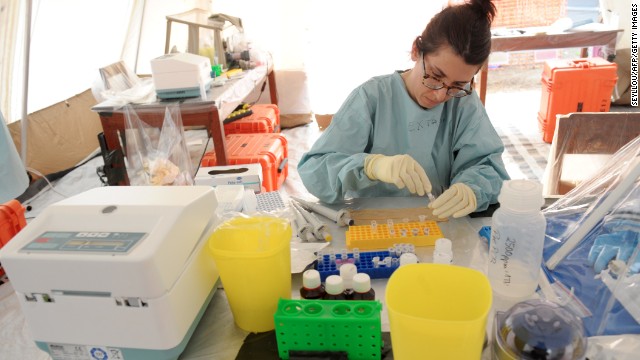 A health specialist works Monday, March 31, in a tent laboratory set up at a Doctors Without Borders facility in southern Guinea.
 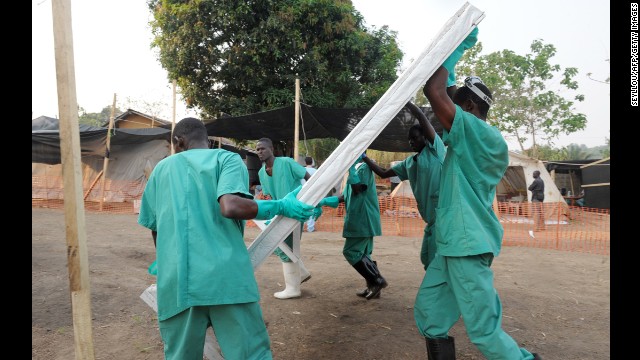 Health specialists work March 31 at an isolation ward for patients at the facility in southern Guinea.
  Workers associated with Doctors Without Borders prepare isolation and treatment areas Friday, March 28, in Guinea.
 Ebola outbreak in West Africa
Ebola outbreak in West Africa
Ebola outbreak in West Africa
Ebola outbreak in West Africa
Ebola outbreak in West Africa
Ebola outbreak in West Africa
Ebola outbreak in West Africa
Ebola outbreak in West Africa
Ebola outbreak in West Africa
Ebola outbreak in West Africa
Ebola outbreak in West Africa
Ebola outbreak in West Africa
Ebola outbreak in West Africa
Ebola outbreak in West Africa
Ebola outbreak in West Africa
Ebola outbreak in West Africa
Ebola outbreak in West Africa
Ebola outbreak in West Africa
Ebola outbreak in West Africa
Ebola outbreak in West Africa
Ebola outbreak in West Africa
Ebola outbreak in West Africa
Ebola outbreak in West Africa
Ebola outbreak in West Africa
Ebola outbreak in West Africa
Ebola outbreak in West Africa
Ebola outbreak in West Africa
Ebola outbreak in West Africa
Ebola outbreak in West Africa
Ebola outbreak in West Africa
Ebola outbreak in West Africa
Ebola outbreak in West Africa
Ebola outbreak in West Africa
Ebola outbreak in West Africa
Ebola outbreak in West Africa
Ebola outbreak in West Africa
Ebola outbreak in West Africa
Ebola outbreak in West Africa
Ebola outbreak in West Africa
Ebola outbreak in West Africa
Ebola outbreak in West Africa
Ebola outbreak in West Africa
Ebola outbreak in West Africa
Ebola outbreak in West Africa
Ebola outbreak in West Africa
Ebola outbreak in West Africa
Ebola outbreak in West Africa
Ebola outbreak in West Africa
Ebola outbreak in West Africa
Ebola outbreak in West Africa
Ebola outbreak in West Africa
Ebola outbreak in West Africa
Ebola outbreak in West Africa
Ebola outbreak in West Africa
Ebola outbreak in West Africa
Ebola outbreak in West Africa
Ebola outbreak in West Africa
Ebola outbreak in West Africa
Ebola outbreak in West Africa
Ebola outbreak in West Africa
Ebola outbreak in West Africa
Ebola outbreak in West Africa
Ebola outbreak in West Africa
Ebola outbreak in West Africa
Ebola outbreak in West Africa
Ebola outbreak in West Africa
Ebola outbreak in West Africa
Ebola outbreak in West Africa
Ebola outbreak in West Africa
Ebola outbreak in West Africa
Ebola outbreak in West Africa
Ebola outbreak in West Africa
Ebola outbreak in West Africa
Ebola outbreak in West Africa
Ebola outbreak in West Africa
Ebola outbreak in West Africa
Ebola outbreak in West Africa
Ebola outbreak in West Africa
Ebola outbreak in West Africa
Ebola outbreak in West Africa
Ebola outbreak in West Africa
Ebola outbreak in West Africa
Ebola outbreak in West Africa
Ebola outbreak in West Africa
Ebola outbreak in West Africa
Ebola outbreak in West Africa
Ebola outbreak in West Africa
Ebola outbreak in West Africa
Ebola outbreak in West Africa
Ebola outbreak in West Africa
Ebola outbreak in West Africa
Ebola outbreak in West Africa
Ebola outbreak in West Africa
Ebola outbreak in West Africa
Ebola outbreak in West Africa
Ebola outbreak in West Africa
Photos: Ebola outbreak in West Africa  Residents worried about contracting Ebola
 On September 30, a blood test confirmed Duncan had Ebola. He remains at the hospital in serious but stable condition, health officials say.
On Friday, Dallas County Health and Human Services director Zachary Thompson told CNN's "New Day" that the Ebola situation in the city is "under control."
"It is contained," Thompson said. The Ebola patient's "family is being monitored. There is no outbreak. And so therefore everyone should ease their fears and allow public health officials ... to respond to this issue."
Cleanup delayed
Duncan was in Dallas visiting his son and his son's mother, his half-brother, Wilfred Smallwood, said.
Duncan's partner, who asked to be referred to only by her first name, Louise, along with her son and two nephews in their 20s, are in isolation at the apartment, which still has the sheets, clothes and towels Duncan used.
A plan to sanitize the apartment was delayed late Thursday.
Brad Smith of the Cleaning Guys, which was hired to sanitize the apartment, said his company is ready to go but a permit issue has stopped them from entering the home. Smith says a specialized permit, which is handled by the state government, is needed to transport this type of unprecedented hazardous waste on Texas highways. Cleaning Guys specializes in hazmat and biohazard cleaning services, but it does not transport the materials.
Ebola can spread through contact with an infected person's bodily fluids like blood, feces or vomit. CDC spokeswoman Abbigail Tumpey says the CDC considers materials contaminated with Ebola as regular medical waste, and as such, can be disposed of as medical waste. But she said the Department of Transportation considers Ebola to be a Category A agent, which means it's illegal to transport.
"The CDC and the DOT regulations have been in conflict. It's been an ongoing issue that we've been dealing with. We hope to have a resolution on that literally today."
"This is a unique situation," Smith said. "Once awarded, our hazmat teams will be allowed back inside to do their jobs."
Louise told CNN's Anderson Cooper that she used bleach to clean her apartment, "but it's not clear to me how systematic the cleaning was," Cooper said.
Three Dallas County sheriff's deputies have been placed on leave after helping deliver court orders to the four family members, Sheriff's Department spokeswoman Carmen Castro said Friday.
The trio escorted a Dallas County Health and Human Services worker on Wednesday who was delivering the orders, which placed the family members inside the apartment under quarantine until October 19. Castro says the deputies' leave is precautionary for their peace of mind.
Where are the students?
On Wednesday, Dallas Independent School District Superintendent Mike Miles said five school-age children who attended four different schools had come into contact with Duncan and were being monitored at home for Ebola symptoms.
 4 people quarantined in U.S. Ebola scare
  Dallas mayor: Safety is first priority
 Ebola preps difficult for hospitals  Survivor describes living through Ebola
 It is unclear if the young boy quarantined with Louise is one of those children, or how the five students came in contact with Duncan.
On Thursday, district spokesman Andre Riley told CNN that one of those students went to Sam Tasby Middle School on Wednesday
"We're not sure why the Tasby student showed up for school on Wednesday but, once he was identified, he was asked to go to the nurse's office so that a parent could be contacted," Riley said in an email. "During the limited time he was on campus, he showed no symptoms."
The students have been asked not to attend school "out of an abundance of caution," Riley said.
Questions about hospital procedure
Hospital officials have acknowledged that Duncan's travel history wasn't "fully communicated" to doctors when he first came to the hospital on September 26, but also said in a statement Wednesday that based on his symptoms, there was no reason to admit him at that time.
"The patient presented with low-grade fever and abdominal pain. His condition did not warrant admission. He also was not exhibiting symptoms specific to Ebola," Texas Health Presbyterian Hospital Dallas said.
"A travel history was taken, but it wasn't communicated to the people who were making the decision. ... It was a mistake. They dropped the ball," said Dr. Anthony Fauci, director of the National Institute of Allergy and Infectious Diseases.
In its early stages, Ebola looks just like a lot of other illnesses. But the Centers for Disease Control and Prevention has been emphasizing the need to ask all patients with these symptoms for a travel history.
"You don't want to pile on them, but hopefully this will never happen again," Fauci told CNN's "The Lead with Jake Tapper."
The CDC is now distributing pamphlets to hospitals in the hope of increasing awareness. One pamphlet is a checklist for patients being evaluated for Ebola. The other is a flowchart for evaluating travelers who have returned from an Ebola-affected country.
Did he lie to come to the United States?
Before leaving his homeland, Duncan answered no to questions on a travel form about whether he was exposed to the deadly virus, said Binyah Kesselly of the Liberia Airport Authority.
Yet Duncan had been helping Ebola patients, including caring for one at a residence outside the capital of Monrovia, Liberian community leader Tugbeh Chieh Tugbeh told CNN.
Liberia Airport Authority officials said they may prosecute Duncan if he lied on his health screening questionnaire before leaving for the United States.
President Ellen Johnson Sirleaf told Canadian public broadcaster CBC that she would consult with lawyers to decide what to do with Duncan when he returns home.
"The fact that he knew (he was exposed to the virus) and he left the country is unpardonable, quite frankly," Johnson Sirleaf said.
"With the U.S. doing so much to help us fight Ebola, and again one of our compatriots didn't take due care, and so, he's gone there and ... put some Americans in a state of fear, and put them at some risk, and so I feel very saddened by that and very angry with him, to tell you the truth."
Duncan hadn't mentioned any exposure to the disease, said Smallwood, Duncan's half-brother. He added that he doesn't believe Duncan knew he had Ebola when he left Liberia.
Duncan was screened three times before he boarded his flight in Liberia bound for Brussels, said Kesselly of the Liberia Airport Authority. His temperature was a consistent 97.3 degrees Fahrenheit, said Thomas Frieden, chief of the CDC.
After his connection through Brussels, he flew to Washington, and then to Dallas.
Dozens may have had contact with him
Health officials are reaching out to as many as 100 people who may have had contact with Duncan while he was contagious, a Texas Department of State Health Services spokeswoman said Wednesday. They are being questioned because they may have crossed paths with the patient.
So far, no one who had contact with him has shown any signs of Ebola, Dallas County Judge Clay Jenkins said.
The number of direct contacts who have been identified and are being monitored right now is "more than 12," a federal official told CNN.
Monitoring means a public health worker visits the contacts twice a day to take temperatures and to ask if they are experiencing any symptoms.
More U.S. troops will be sent to West Africa
The Pentagon will announce that an additional 600 American troops will be sent to West Africa in support of the fight against the Ebola outbreak, a U.S. military official told CNN's Barbara Starr on Friday.
The troops will provide engineering and logistics support, the official said. The United States had already committed to sending 3,000 troops to the region.
About 200 U.S. troops are in West Africa now, Pentagon spokesman Rear Adm. John Kirby told CNN's "New Day" Friday.
The U.S. troops will not treat patients, but will help establish health facilities and medical treatment units "so that the health care workers can do their jobs," Kirby said.
Widow of Ebola victim: Outbreak is everyone's problem
NBC cameraman infected
Plans are also being made to bring an American cameraman who was diagnosed with Ebola in Monrovia home to the United States.
Ashoka Mukpo, 33, a freelance cameraman for NBC News, will return to the U.S. for treatment aboard a private charter plane.
Mukpo started feeling achy and tired Wednesday, and he quarantined himself. A day later, a test at a Doctors Without Borders facility in Monrovia confirmed that he had Ebola.
The cameraman is believed to be the fourth American stricken by the disease while in Liberia.
Dr. Kent Brantly, Nancy Writebol and Dr. Rick Sacra all contracted the disease while working in the country.
All three recovered after they were evacuated from Liberia and treated at hospitals in Atlanta and Omaha, Nebraska.
CNN's Dave Alsup and Catherine E. Shoichet contributed to this report.

0 comments:
Post a Comment