 Stargazers in the UK can enjoy the silhouette of the Llanthony Priory against the starry sky. The ruins have partly been converted into a pub. After a night of hard sky observation, you can step into the former Augustinian priory for an authentic Welsh ale.
  The natural Owachomo Bridge in Utah is silhouetted against the Milky Way and thousands of stars. This photo was taken on a particularly clear night after a storm, and features potholes full of water reflecting the scene, says photographer Jacob Frank.
  Westhavelland International Dark Sky Reserve is less than a two-hour drive from Berlin. The summer night sky can be so dark and clear that zodiacal light (sunlight scattered by dust in space) and gegenschein (a faint brightening of zodiacal light at midnight) can be visible.
 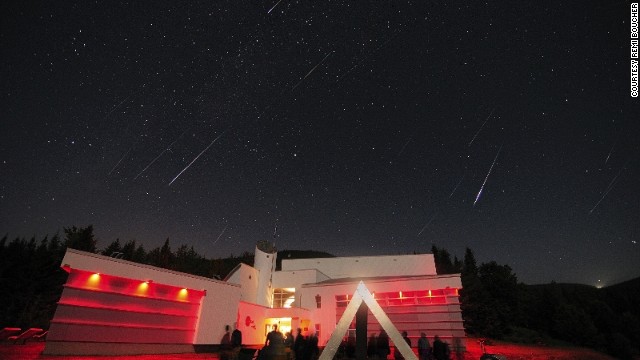 The annual Perseids Event at Mont-Mégantic is dedicated to the meteor shower that can be seen every August. Around 50-100 "fireballs" can be seen per hour across the sky in Quebec, Canada.
 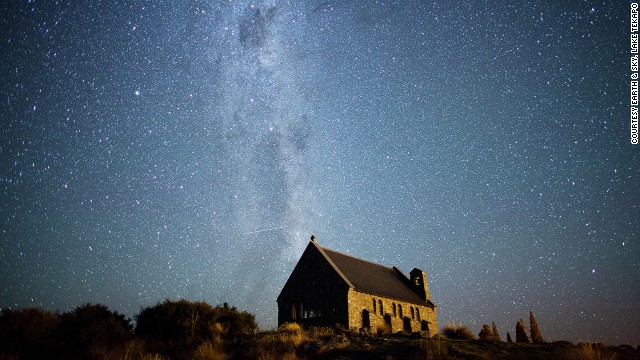 Looking south from Lake Tekapo, on the South Island in New Zealand, you can see the Milky Way stretching over the Church of the Good Shepherd. The Southern Cross and the Coal Sack Nebula are visible near the top of the image.
 A long exposure or multiple stacked images can capture the motions of stars as the Earth rotates. As you focus toward the north or south poles, stars create a circular trail. On the clearest nights, 3,000 stars are visible over this park in Devon and Somerset, UK.  It's impossible to miss the Milky Way stretching across the sky from this French reserve. "Starry Night" programs are available on special astronomical occasions in the reserve, where an astronomer acts as your guide to the cosmos. You can use viewing equipment on the terraces.
 The light extending upwards from the horizon is zodiacal light, says Dr. George Tucker, a former professor of physics and astronomy. The Beehive Cluster is in the center of the light by the Namibian horizon with the constellation of Cancer around it and the stars of Leo above.  Orion is one of several constellations that can be seen at this dark sky reserve in Ireland. In this photo, and with the naked eye when there, you can see the Milky Way, the Andromeda Galaxy and the Orion Nebula.
 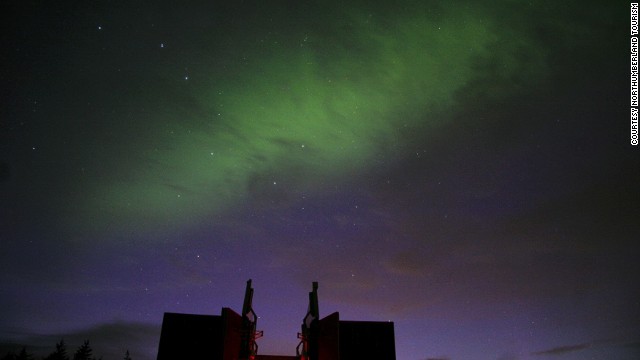 Depending on disturbances in the Earth's magnetic field, the Aurora Borealis can be visible from Kielder Observatory, on the northern-most edge of England, close to the Scottish border.
 Looking toward Oregon's Mount Hood during autumn, you can see Saturn (smaller than the dot of this "i" at the top left) and Venus (right of the moon) with the naked eye. If you want a better view of the tiny speck that is Saturn, you can use the park's telescope, one of the largest available for public use in the United States. 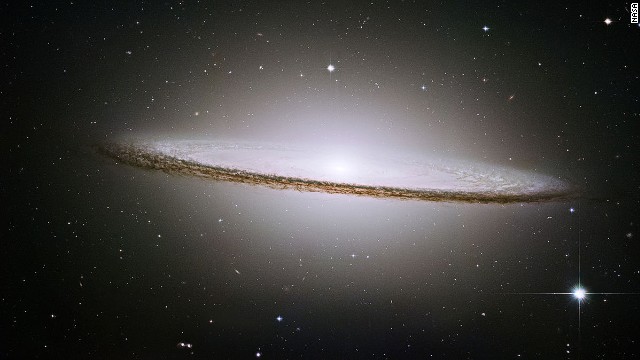 The Sombrero Galaxy can be seen with an amateur telescope from Death Valley National Park in California. This image is a mosaic of six photos taken by the Hubble Space Telescope. Many astronomers speculate that a black hole a billion times the mass of our sun is at the "Mexican hat's" center.
  You can observe sky phenomena among ancient Pueblo ruins as Chacoan people did almost 1,000 years ago. In addition to regular events, including archaeo-astronomy and Pueblo Bonito full moon walks, special events are held for phenomena such as eclipses and meteor showers.
 Pristine night skies were a perk and a necessity for Hortobágy's traditional shepherds in Hungary. Early 20th-century shepherds relied heavily on knowledge of stars and constellations for livelihood and cultural reasons. Star formations or "stellar nurseries" can be seen without the use of equipment in this park in Scotland, but details of the nebulae are better observed through one of the two telescopes at the Scottish Dark Sky Observatory, bookable from $8 per person.  In this picture the swirl of the Milky Way can clearly be seen from Panther Junction, the center of Big Bend National Park in Texas. Among the stars, you can also see the constellations Gemini, Taurus and Orion. It's the only dark sky park in the Northern Hemisphere where you can see parts of the Southern Cross.
 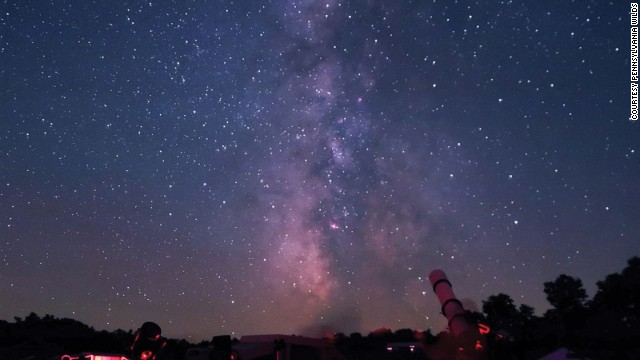 Visibility at Cherry Springs can be so good that the Milky Way is sometimes bright enough to cast shadows on the ground.
 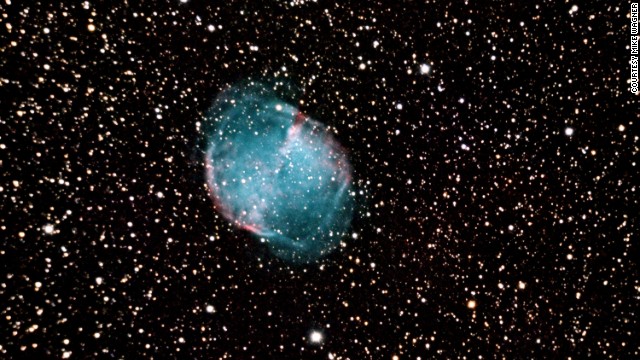 Using this park's telescope, you can see deep sky objects such as the Dumbbell Nebula. The nebula is the remains of exploded stars and stretches 4.5 light years across.
 The Northern Cross is part of the constellation of Cygnus. This image was captured in Observatory Park, Geauga Park District in Ohio, but the constellation can be clearly seen at Clayton Lake Dark Sky Park in New Mexico during the summer too.  In the Blue Ridge Mountains of North Carolina, this new dark sky park is one of few places on the east coast to offer spectacular views of the Milky Way.
  The Orion constellation and Orion Nebula can be seen in the Northern Hemisphere during spring. Paul Jeanes captured this image of the Orion Nebula (also known as M42) from his observatory in Washford, UK, but it can also be seen from Hungary's Zselic Starry Sky Park.
  The Headlands are one of the best stargazing destinations in the United States. During the larger meteor showers such as the Perseids (which peak mid-August) and the Geminids (which peaks mid-December) you can watch the "falling stars" streak in front of the Milky Way.
- May Camelopardalids could light up skies over North America early Saturday
- The meteor shower is from the Earth passing through the debris of a comet
- Forecasters say it will produce as few as 100 or as many as 1,000 meteors an hour
- Scores of people on Twitter express excitement about the cosmic event
Planning to catch the meteor shower this weekend? Share your best shots with CNN iReport, and you could be featured on CNN.
(CNN) -- When the sky falls, you'd think people would run for cover.
Not tonight.
If the clouds cooperate, skies all over North America will light up between 2 a.m. and 4 a.m. ET Saturday in a rare sight that's excited everyone from space geeks to insomniacs to regular folks.
"I AM SO PUMPED FOR THE METEOR SHOWER TONIGHT OMG," tweeted one woman.
 Perseid meteor shower lights up the sky
  Time-lapse of the Perseid meteor shower
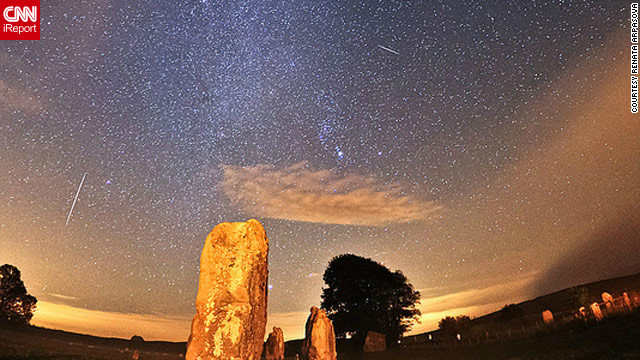 Renata Arpasova spent the early morning hours Sunday photographing the Orionid meteor shower from Wiltshire, England.
  Determined to experience his first meteor shower undisturbed by cloudy skies, Robbie López drove out to Chester, Virginia, to photograph the Orionids.
  Kevin Lewis stayed up late and braved cold weather just so he could experience the serenity of watching the Orionids from North Wales.
  Robbie López stood out in a remote field in Chester, Virginia, to photograph the Orionid meteor shower.
  Mike Black photographed the Orionids at 5:00 a.m. from Belmar, New Jersey. "It is worth it to see this natural phenomenon. I am always excited when I see one, it never gets old or boring or tiring," he said.
 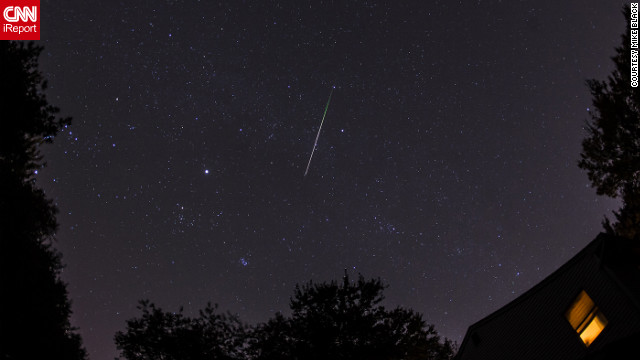 As a science teacher, Mike Black says he has always been a fan of meteor showers. "They remind us that we live on a small rocky world with other bits of rock flying around space," he said.
  Using a Canon 5D Mark II camera, Mike Black photographed the Orionid meteor shower early Sunday morning. "When one of those bits of rock enters our atmosphere, it burns up and we get to enjoy a meteor shower. It's just one of nature's spectactular shows," he said.
 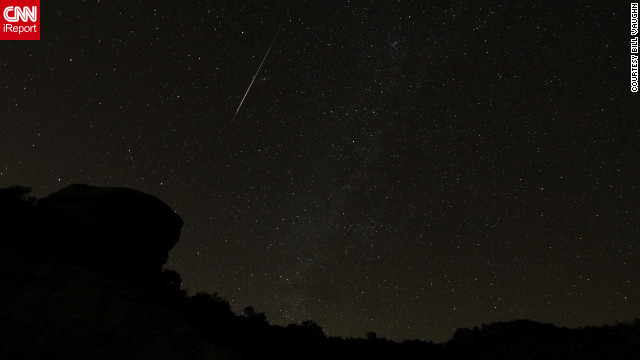 Bill Vaughn says he always enjoys watching a meteor shower with his wife, especially because they never know what to expect. He photographed the Orionids from Mount Lemmon, Arizona.
 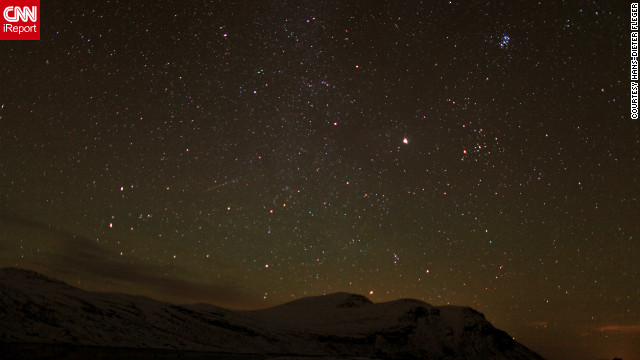 Hans-Dieter Fleger photographed the Orionid meteor shower from the foot of Mount Gaustatoppen in Stavsro, Norway, early Sunday morning.
 Capturing the Orionid meteor shower Actually, these meteors aren't necessarily falling on the Earth. Rather, it's the Earth that's moving through the debris of Comet 209/P Linear.
Whatever the reason, experts say this one-night-only phenomenon known as the May Camelopardalids could produce a huge light show -- or be a dud. NASA's Jet Propulsion Laboratory noted that some forecasters are predicting about 100 meteors per hour, while others have much higher expectations, predicting more than 1,000 meteors per hour.
It's not like there's a lot of history to say which way things will go.
"We have no idea what the comet was doing in the 1800s," said Bill Cooke, the head of NASA's Meteoroid Environment Office. "The parent comet doesn't appear to be very active now, so there could be a great show or there could be little activity."
Awe-inspiring photos: 'Blood moon' mesmerizes sky gazers
Still, the mere prospect of a big light show is enough to get people up in the middle of the night -- if they go to sleep at all -- to take it all in. CNN Meteorologist Sean Morris noted that this is the first time in a generation that Earthlings can see a new meteor shower.
This cosmic event has been years in the making: NASA announced in 2012 that Earth would encounter debris from this comet -- which also rotates around the sun -- crossing our orbit this weekend.
The meteors should radiate from a point in Camelopardalis, a faint constellation near the North Star that's also known as "the giraffe," Cooke said.
The Jet Propulsion Laboratory recommends that those who want to see the show find a spot away from city lights, give themselves time to adjust to looking at the night sky and use their own eyes (no binoculars necessary) to enjoy the view.
The best place to watch the shower will be east of the Mississippi River or in California. The worst may be parts of the Plains and Northeast, where rain and cloud cover is possible. If you're in Europe, Africa, Asia or South America, don't even bother to look.
Several people tweeted about what they'll be wishing on, while others wished for someone with whom they could enjoy the occasion.
"Meteor shower tonight!!!!!" read one post. "Everyone turn off lights, go outside, put down blankets, cuddle up and enjoy!!!!
But not everyone is comfortable with the spectacle, it seems.
"Everyone wants me to watch the meteor shower," tweeted one woman, "but I think he deserves his privacy."
Astronaut tells kid, 'You'd love it up here'
CNN's John Newsome contributed to this report.

0 comments:
Post a Comment